

Freefly Ember S2.5K High-Speed Scientific Imaging Camera

Key Features
- High-speed 2.5K capture
- Continuous fast recording
- Global shutter sensor
- Active EF lens mount
- Pre-record buffer
- High-endurance SSD
Description
Freefly Ember S2.5K High-Speed Scientific Imaging Camera
It is a compact, precision-engineered imaging platform specifically developed for ultra-high temporal resolution applications in scientific research, engineering diagnostics, and industrial testing environments. It combines a specialized large-pixel Super 35 sensor architecture with a robust continuous-to-SSD recording subsystem, delivering frame rates unattainable in conventional high-speed systems while eliminating the operational limitations imposed by volatile buffers. This design enables reliable, long-duration capture of transient physical phenomena without interruption, supporting repeatable experimentation and comprehensive data acquisition workflows.
Core Technical Specifications:
-
High-Speed Acquisition Capabilities:
- Full sensor readout (2560 × 2048): Sustained rates up to 2277 frames per second (fps).
- Reduced-width modes (e.g., 2048 × 1080 or equivalent): Up to 2900 fps.
- Maximum achievable rates in cropped or height-reduced configurations: Up to 3563 fps (observed in narrower window heights such as 864h or 1024h vertical pixels).
- Advanced readout modes include 2×2 pixel binning (enhancing sensitivity and reducing readout noise in monochromatic or low-light scenarios) and flexible windowing/cropping for custom aspect ratios, allowing users to trade spatial resolution for temporal resolution in a highly deterministic manner.
-
Sensor Architecture:
- Global electronic shutter Super 35 (S35) format Gpixel sensor incorporating Quad Bayer color filter array technology; native resolution 2560 × 2048 pixels (approximately 5.2 megapixels effective); active imaging area measuring 23.04 mm × 18.43 mm; pixel pitch of 9.0 µm, deliberately enlarged to maximize photon collection efficiency and signal-to-noise performance under extreme frame-rate conditions.
-
Dynamic Range & Radiometric Performance:
Nominal dynamic range of approximately 11 stops (inherent engineering trade-off prioritizing speed and sensitivity over extended tonal latitude); native ISO settings stepped at 100, 200, and 400, with optimal performance typically centered around ISO 400 for most high-speed scientific imaging tasks. -
Recording Subsystem:
Internal 2.56 TB pSLC-grade NVMe M.2 SSD engineered for extreme endurance (rated for sustained write throughput exceeding 80 petabytes total lifetime or >10,000 hours of continuous high-frame-rate operation); recording is strictly limited only by available storage capacity, with no per-clip duration caps; encoded in 10-bit ProRes 422 LT format to balance image fidelity, file manageability, and compatibility with professional post-processing pipelines; configurable pre-record buffer (adjustable from 1 second to 2 hours) preserves critical lead-in events prior to trigger activation. -
Mechanical & Integration Design:
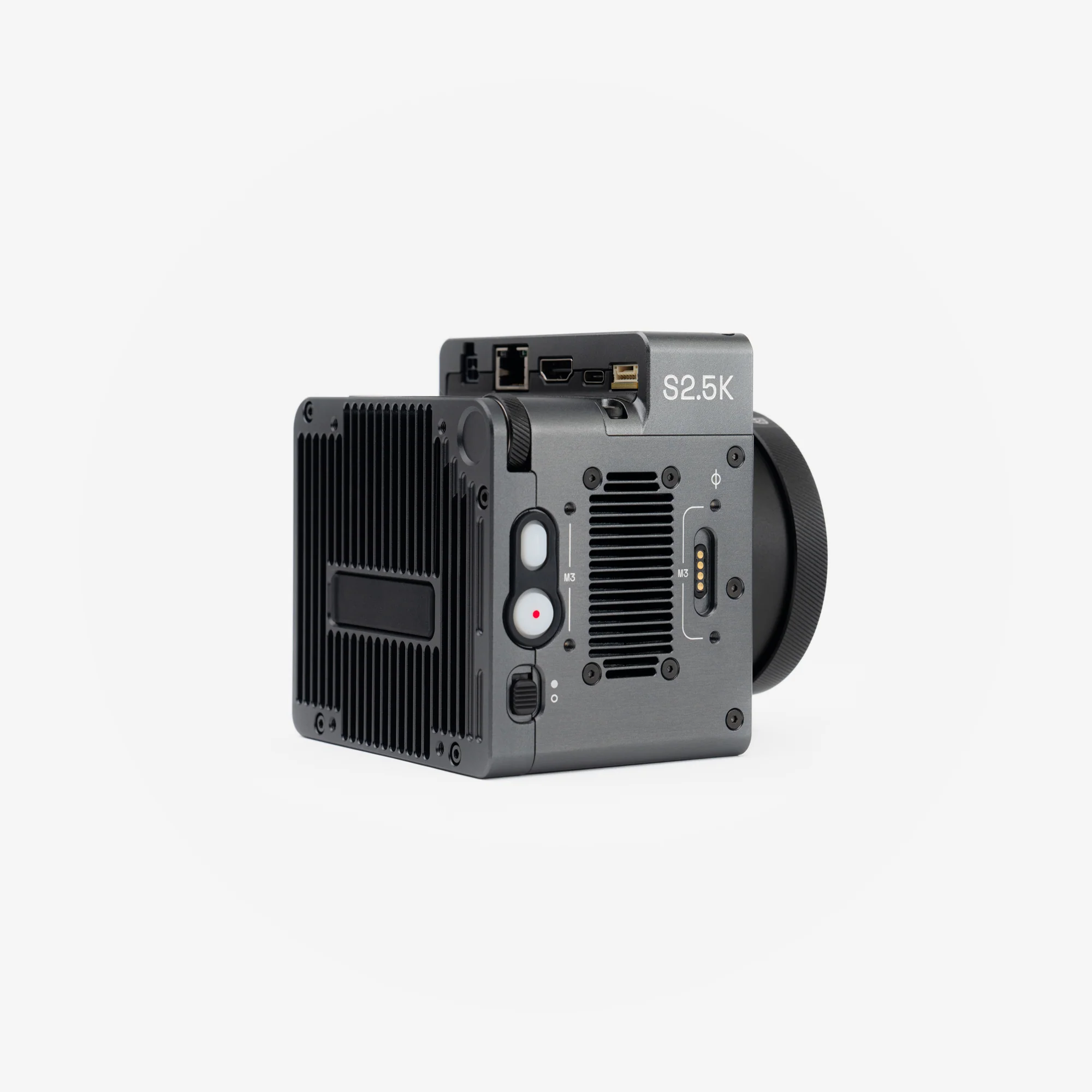
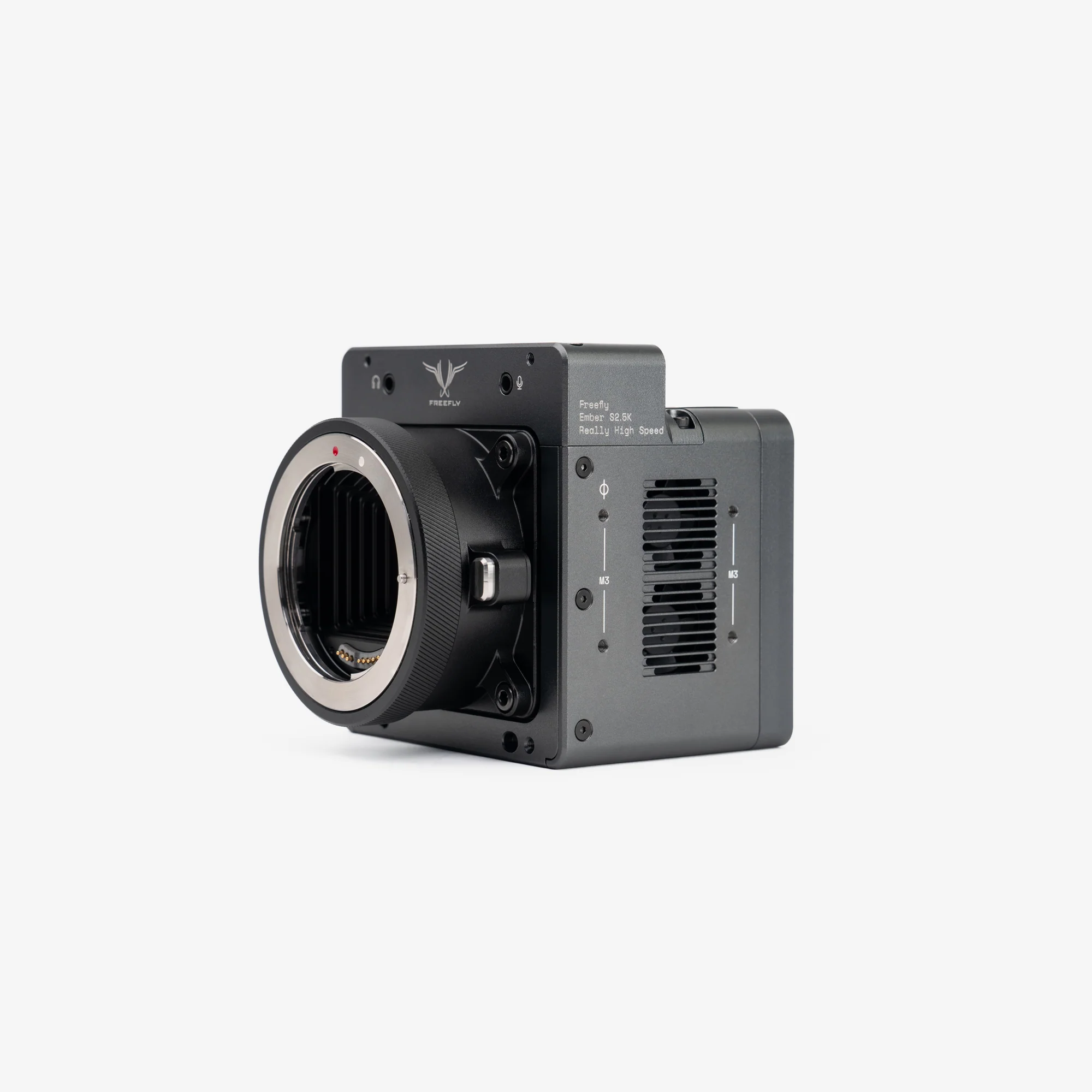
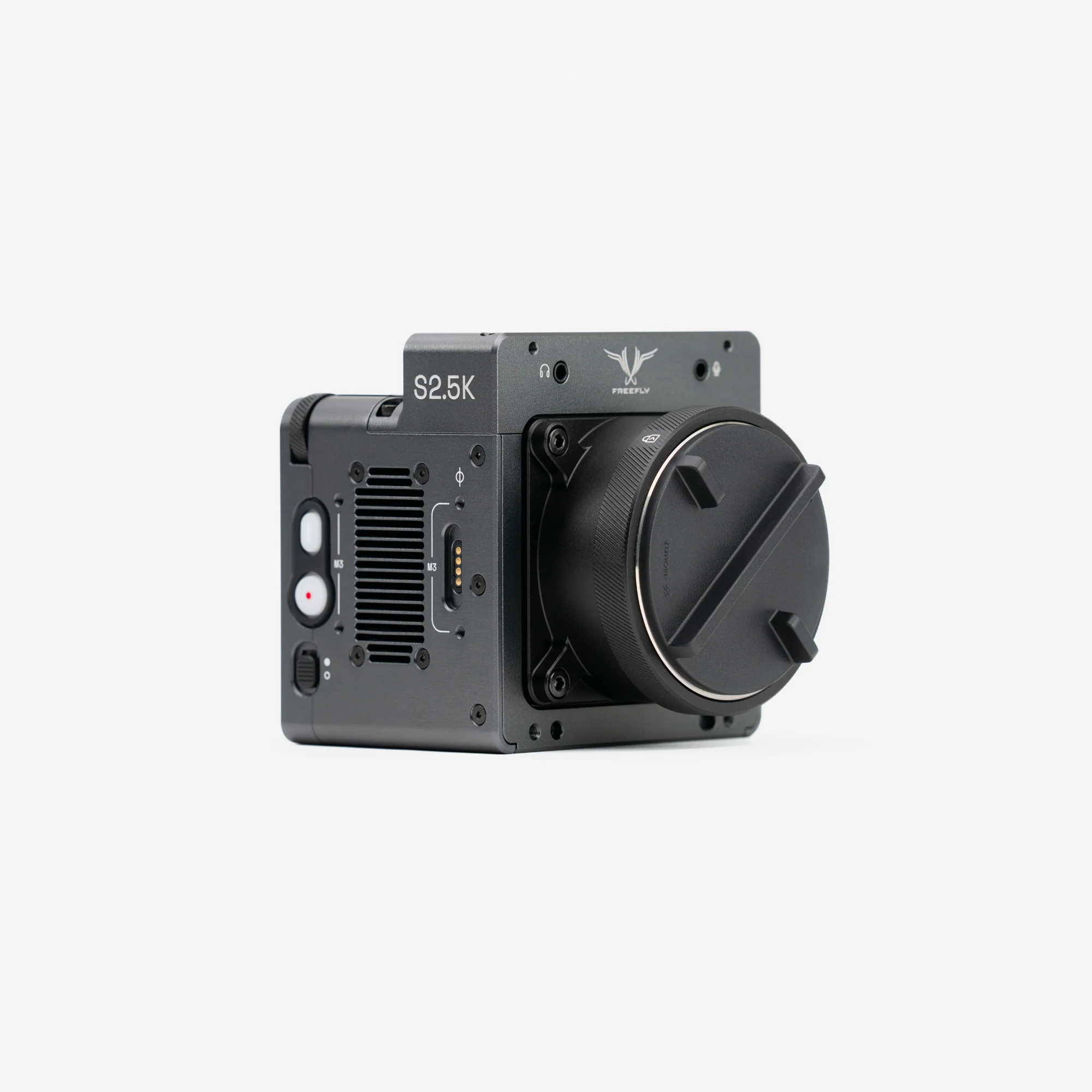
Precision-machined cube-form chassis dimensions approximately 100 mm × 104 mm × 108 mm (including active EF mount protrusion); body mass in the range of 800–918 g depending on exact configuration; extensive array of 1/4”-20 threaded inserts and M3 mounting points distributed across all faces for modular rigging, vibration isolation, or enclosure integration; native active Canon EF lens mount providing full electronic control over iris, focus, and metadata communication with compatible EF-series optics; field-adaptable to alternative mounts (e.g., PL, passive E-mount) via precision adapter kits.
The Ember S2.5K is expressly tailored for research and diagnostic scenarios that demand sub-millisecond temporal granularity, distortion-free global shutter imaging, and extended acquisition windows. Representative deployment areas include:
• High-velocity impact, penetration, and material failure characterization (e.g., ballistic testing, crashworthiness evaluation, hypervelocity projectile studies, and fracture mechanics under dynamic loading).
• Combustion and propulsion system research (detailed observation of fuel injector atomization, flame kernel development, detonation wave propagation, and afterburner plume dynamics).
• Biomechanical motion capture and neuromuscular performance analysis (precise quantification of rapid joint kinematics, muscle-tendon interactions, and gait anomalies in sports science, rehabilitation engineering, or prosthetics validation).
• Full-field digital image correlation (DIC) for non-contact measurement of strain, displacement, vibration amplitude, and stress distributions on complex geometries under transient excitation.
• Defense-oriented applications, including projectile trajectory tracking, explosive event reconstruction, ordnance fragmentation studies, and high-speed target signature analysis.