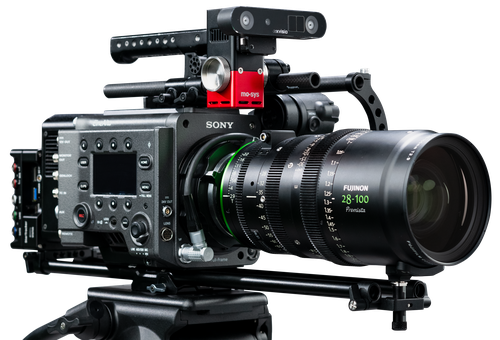
Mo-Sys VisionMax

Key Features
- Extends StarTracker Max tracking into unmapped environments.
- Uses vSLAM technology to track environmental features.
- Automatically switches tracking when stars become obscured.
- Smoothly resumes star-based tracking when stars reappear.
- Quick-release V-lock mounting supports flexible sensor positioning.
- USB-powered design consumes less than three watts.
- Requires no additional calibration or homing procedures.
Description
Mo-Sys VisionMax – Expand Your Camera Tracking Possibilities
Take the shot beyond the mapped studio.
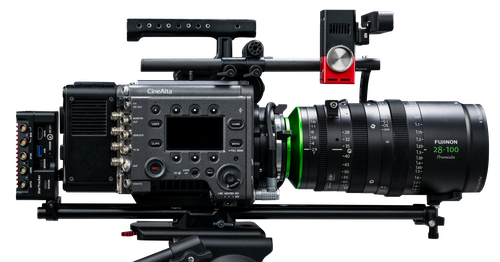
Creative camera movement can take a production beyond its carefully prepared tracking area. Mo-Sys VisionMax extends the capabilities of StarTracker Max into unmapped shooting environments, providing fallback tracking when tracking stars are lost. When stars become visible again, the system smoothly returns to star-based tracking through data fusion—giving production teams greater flexibility when planning ambitious camera moves.
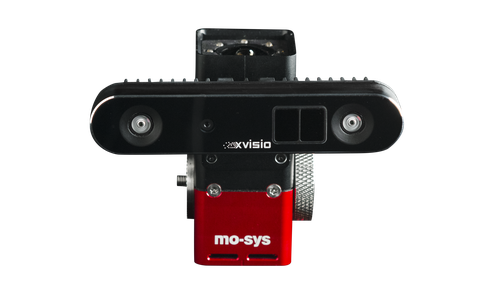
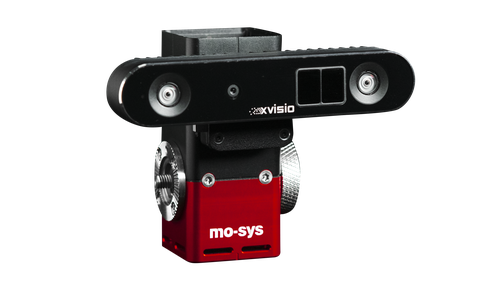
Designed as a compact camera tracking accessory, VisionMax uses vSLAM technology to follow environmental features. It supports StarTracker Max when its sensor cannot see enough tracking stars, helping extend virtual production camera tracking into areas beyond the primary studio setup.
More Freedom to Explore the Scene
A camera move may need to travel beneath an object, enter a vehicle or continue into a space without installed tracking stars. VisionMax gives StarTracker Max an additional tracking source for these situations. Mo-Sys demonstrates this approach as a way to expand shooting flexibility, with the secondary attachment taking over tracking duties when required and handing back to star tracking once sufficient stars are visible.
For directors and cinematographers, this opens up more ways to connect spaces within a shot and explore camera positions that would otherwise challenge a star-only tracking setup.
Automatic Operation Within Your Existing Workflow
VisionMax begins from a position established through StarTracker Max’s star-based tracking. Its onboard visual tracking supplies pose data, which StarTracker Max combines with its own tracking information.
Once attached, enabled and initialised from the stars, operation is transparent to the user. There is no separate calibration or homing procedure, and the existing interfaces with lenses and the virtual set remain unchanged. This makes VisionMax a practical addition for productions that want to extend their tracking coverage while retaining a familiar operating workflow.
Compact Hardware with Flexible Mounting
VisionMax attaches using a quick-release V-lock mount and receives power from StarTracker Max through USB. Mounting presets on four sides, together with custom offsets, allow positioning to suit the shot. Floor, ceiling and horizontal sensor configurations are supported. Its 100 g weight and typical consumption below 3 W keep the accessory compact and power-efficient.
Built Around the Needs of Virtual Production
Camera tracking provides the connection between physical camera movement and the digital elements seen on screen. It helps virtual environments and AR graphics respond to camera movement with the correct perspective.
Within the Mo-Sys camera tracking range, VisionMax adds vSLAM support to the StarTracker workflow. It is relevant to teams building virtual production, VFX and live broadcast systems where maintaining tracking coverage is an essential part of convincing visual integration.
Understanding the Best Operating Conditions
VisionMax performs best with consistent lighting, visible surface texture and a mostly static scene. Plain surfaces, moving people, changing LED imagery and sudden lighting changes can make environmental tracking more challenging. Some drift or jitter can occur, and Mo-Sys recommends testing the intended shooting environment beforehand.
Star-based tracking remains the primary reference, with VisionMax providing additional coverage where placing or seeing stars is impractical.